Special Bug Pages

Showing posts with label Emotional Control. Show all posts

Saturday, May 17, 2014

A Little Stress is a Good Thing

“Emotion is not the problem. It’s the key to mastering your game.”
– Jared Tendler, Poker Psychologist

Unless you’re brain dead or some kind of alien robot, playing poker for money will bring out emotions in you, both good and bad. Playing competitive poker causes stress.

And guess what? Neither of these things is necessarily bad for you or your play. In fact, a little stress and emotional arousal can be beneficial to your game and can give you a competitive edge… but only up to a point. Then things start to go south again. Let me explain.

Many uninformed poker pundits, arm-chair coaches, and so-called experts frequently say that you have to be emotionally dead at the tables. They write things like: “to win at poker you have learn to totally let go of caring,” and “don’t think about the money or how you’re doing—you have to learn to not give a crap.”

I used to buy into this notion, as do many amateur players and otherwise smart people that should know better. For instance, I was reading a well-regarded poker strategy book the other day and saw a quote by Katy Lederer, sister of the infamous poker scoundrels Howard Lederer and Annie Duke. In this otherwise solid book, Katy was quoted as saying:

“The cardinal sin in poker, worse than playing bad cards, worse even than figuring your odds incorrectly, is becoming emotionally involved.”

Sounds reasonable, right?

Bzzzzzzzzzt, wrong!

What Katy espouses is a common misunderstanding of the game by beginners. We (correctly) take the level-1 advice of learning to not focus on the results of a specific poker hand, and we expand it (incorrectly) to mean we should learn to completely divest ourselves emotionally during play. These two things are not the same. The former is good advice, the latter quite bad.

The simple truth is you need to care emotionally. You need to be a little stressed. You need to be aroused and focused and peaked. Or else you’re not playing optimally.

Sports psychologists have known about the relationship between stress and performance for years—over a century in fact. Way back in 1908, the researchers Robert Yerkes and John Dodson performed a series of experiments that resulted in something called, not surprisingly, the Yerkes-Dodson (YD) law.

The YD Law states that performance at a task increases with physiological and/or mental arousal. But depending upon the difficulty of the task, this performance increases only up to a point. When levels of arousal become too high, performance decreases. The process is often illustrated graphically as an inverted U- or bell-shaped curve which increases and then decreases with higher levels of emotional arousal. Here's a cartoon version of the YD Law to illustrate the relationship between arousal and performance:


Continued research in this field has found that different types of tasks require different levels of arousal for optimal performance. For example, simple tasks require a relatively large amount of arousal to achieve optimal performance, while more difficult or intellectually demanding tasks require a lower—but still finite—level of arousal (to facilitate concentration).

Playing competitive poker for money clearly falls into the latter category. Poker is complex and intellectually demanding. This means you need to be emotionally aroused when you play, you need to feel the stress of the game—but only up to a point. Too much stress or arousal can cause sensory overload, fatigue, fear, poor decisions, and so on. In other words: tilt.


Tendler really nails it when he writes that emotions aren’t our enemy at the felt—quite the opposite, in fact. 
Understanding--and using to our advantage--our emotions at the poker table are a fundamental key to mastering the game. And embracing the stress part of poker is part of this over-arching emotional puzzle that is poker.


A little stress does in fact go a long way.

All-in for now...
-Bug

Saturday, April 19, 2014

Sweet and Sour Emotions

Lately, I've been thinking a lot about the right side of my Pyramid of Poker Skills. This is the "Emotional Control" category of skills a poker player needs to master if they want to find their way to the top of the poker dominance heap. You literally can have the best, most refined technical skills and abilities relative to all the players you face in your poker career, and also be the most thoroughly prepared, too, every time you sit down to play, but if you lack the ability to control your emotions once play begins (i.e., tilt) you're almost certainly going to go broke. Probably fast, too.

Poker is a game of people played with cards, and said people are rife with emotions. For the majority of us--and the majority of the time--emotions rule our actions in life, not the other way 'round. The model psychologists often use to describe this is Stimulus -> Response -> Effect.


Said another way, when prodded, we're slaves to our inner response demons, whether we like it or not. Learning to recognize negative stimuli and their corresponding responses in action--and control or short circuit them before they cost us too much--is fundamental to maximizing profit at games of people played with cards, like poker.

I've blogged about this subject off-and-on many times in the past, but have remained somewhat unconvinced I was completely on the right track. Frankly, I'm also unconvinced that the recognized poker psychology experts have fully captured the entire picture of emotions and tilt. Yes, I've read all the standard literature on emotional control in poker, and yes, there are truly excellent books on the subject that are absolutely worth reading. Pretty much anything penned by Jared Tendler, for example, is going to rock your world if you take the time to read it. Tommy Angelo is another unbelievable provoker of thoughts and outside-the-box understandings on the subject of tilt. Schoonmaker, too.

But they all seem to just carve out slices of the overall big picture pie and not a) put it all together into a cohesive whole; and/or b) fully explain how one cognitively attains emotional and psychological control at the table. Angelo, for example, is known for the following insightful statement in his near-legendary Elements of Poker book:

"Tilt has many causes and kinds, but it has only one effect: it makes us play bad. It makes us do things we wouldn’t do if we were at our very best. And that’s how I want to define it, exactly like that. Tilt is any deviation from your A-game and your A-mindset, however slight."

Yes, this is a near perfect definition of Tilt... but it doesn't actually tell us what are all the key types of stimuli that cause this deviation from A-territory-- or more importantly, how we can recognize, master and control each type.

On the other hand, the psychologist Jared Tendler, who has written the two groundbreaking Mental Game books on emotions in poker, does an excellent job dissecting some of the most common forms of tilt. His are really worthwhile books, with very useful descriptions, inputs and techniques to work on, but it seems to me that he leaves out some of the important non-traditional stimuili and tilt responses that are common at the poker tables...

....and on and on. Lots of people have pieces of the puzzle, but no one has fully put it together...

...so I've done a lot of non-poker reading on the subject. A lot. And let me tell you this: there is even more confusion and incompleteness abounding in the academic psychology world on controlling emotions. Lots of theories, lots of pieces of the puzzle, and so on, but very little that is all-encompassing and available that laymen like this Bug can wrap their arms around....

...but then I stumbled on the writings of a non-poker academic by the name of Robert Plutchik, who was Professor Emeritus at the Albert Einstein College of Medicine. Plutchik (now deceased) was known for his work in understanding our human psychology, including something he developed called the "wheel of emotions," which is still used by many researchers to "map" a person's emotional state:

Plutchik's wheel of emotions is used to illustrate and map the majority of different emotions we humans experience. In his wheel, Plutchik claims that there are eight primary bipolar emotions: joy versus sadness; anger versus fear; trust versus disgust; and surprise versus anticipation. Additionally, his model makes connections between the idea of this emotion circle and a color wheel. Like colors, primary emotions can be expressed at different intensities, and can mix with one another to form different, nuanced sub-emotions.

Now, Plutchik's model doesn't seem fully complete, either, at least from a poker emotions point of view. For example, where is "pride" on the chart? Clearly this is an emotion that can can lead to a serious type of tilt (often called "winner's tilt"). And there are other missing items, too...

...but, that said, I think Plutchik's emotion wheel, combined with the ideas of folks like Tendler and Angelo, can lead to a relatively complete and easily digestible approach to recognizing the type of tilt we are on-- and therefore lead to discrete, tangible ways of short-circuiting the stimuli-response tilt process.

Or so I think.

Anyway, this all might sound a little confusing at first, but I'm going to try to tackle the topic in more detail in coming installments. The ultimate goal is a Plutchik-like spoked poker "emotion wheel" of tilt that we can then use as the framework to help recognize negative stimuli and/or responses-- and minimize money lost to tilt.

All-in for now...
-Bug

Monday, October 14, 2013

On Human (Tilt) Bondage: Emotional Control at the Poker Table


The importance of the mental and emotional control aspects of a game like poker cannot be overstated. Every single poker player—from rank beginners to the most experienced professionals—lose money that they should never have to part with. Yes, this means you! And this means me, too.

We all do this because we’re humans, and humans experience emotional mood swings that leads them, er, us, to poor play. Said simply, humans “tilt.”

That’s the bad news; we’re all human. We have emotions and feelings constantly burbling and swirling within us... and this is all going on whilst we’re simultaneously trying to master a game that essentially requires us to be devoid of emotion. We need the ability to suffer bad beats with nary a blip on our emotional register. We have to shrug off coolers like they were nothing more than a harmless gnat buzzing about our head. We have accept losing coin flip after coin flip with carefree indifference. And through all of this, we have to stay on our A-game, playing perfect, disciplined poker...

And I probably don't have to tell you this, but playing like an emotionless android while watching your Aces get cracked yet again by the likes of 7-2o by the worst player at the table is really, really, REALLY hard to do. Why? Because we’re humans, dammit!

Ah, but there’s a glimmer of good news on the horizon on this emotionally troubled sea. As part of putting together the outline of the "Emotional Control" section of my Poker Pyramid of Skills, I've been reading a handful of poker “psychology” books, trying to piece together the collective experts' thoughts on common tilt and psychology issues, along with strategies for recognizing and minimizing their effects on our play. The books I'm reading are: Jared Tendler’s truly excellent The Mental Game of Poker, Ian Taylor/Mathew Hilger's very good The Poker Mindset, Tommy Angelo's classic The Element's of Poker, and Alan Schoonmaker's somewhat disappointing Your Worst Poker Enemy. I've also got Tendler's sequel to Mental on my Amazon to-buy list, as I've heard it's a very good follow-on treatment.

Anyway, as I said, there is some good news on the poker emotion front. In the course of putting together notes and reading all these books, it now appears to me that our human poker frailties fall into just a few common, recurring categories, or themes if you will.  Better still, there seem to be definitive tips, techniques, and strategies for dealing with each of these common issues. Here are the broad Emotional Control categories as I currently see them:
  1. Plane Jane Tilt. Tilt is basically nothing more than Anger, writ poker style. Tilt can be due to running bad, feelings of injustice, feelings of entitlement, revenge, desperation, superstition, and so on, but they're all nothing more than fifty shades of anger.
  2. Lack of Patience and/or Discipline. We want to play poker, dammit. We didn't come here to fold, even though we know we should...
  3. Lack of Focus. We humans are lazy creatures. We're not easily motivated. We're not good at situational awareness. We suck at paying attention. We've mucked, and we'd rather be reading a novel on our iPad or watching the football game on the TV instead of putting the other active players on hand ranges.
  4. Confidence Issues. We've been losing hand after hand, session after session, and we begin to wonder if we're actually capable of ever beating this damn, stupid, f*cking game... 
  5. Ego Issues. This is the flip side of Confidence issues. We're better than these idiots at the table. We feel entitled to win.... i.e., we think we're better than we actually are.
  6. Heart. We play scared, without heart. We're not trusting our reads, and we're certainly not acting on them. We're so afraid of "dying" that we'll never actually live and thrive at the tables.
All poker players lose money at the tables, and they do so because they've succumbed to one or more of these six basic psychological pitfalls. Mastering control of your emotions at the poker table is paramount to mastering the game. Tilt control, discipline, focus, confidence, ego control, and heart—these are the keys to mastering the emotional side of the game.

Well, at least as I see it. I could be wrong. I'm only human, after all....

All-in for now....
-Bug

Friday, March 15, 2013

Categorizing the Mental Game

Read an interesting article the other day by Jared Tendler, who is a relatively well-known "mental game" poker coach, specializing in emotional problems and control. In this article, Tendler breaks down the mental/emotional issues that affect the majority of players into four basic categories:
  1. Tilt. Unlike Tommy Angelo and others who call "tilt" any play that is less than your A-game, Tendler believes that most tilt is in fact a form of anger. The cause of that anger can be many things, such as running bad, revenge, bad beats, hating to lose, making mistakes, feeling cursed, etc., but the bottom line is that tilt = anger. Anger management is therefore key to controlling this emotional leak in your game.
  2. Fear. This is another big area of mental anguish that affects players. Fear can manifest itself by such things as over-thinking decisions, mind going blank in big pots (deer in headlights), feeling rushed, avoiding higher variance plays that you know are right, and just feeling overwhelmed or out-matched by better players than you.
  3. Motivation. Tendler says that you can be over- or under-motivated at the tables, and this can affect your play.
  4. Confidence. Finally, Tendler says that you have to have confidence to play poker well, but too much is just as bad as too little. Being overconfident can lead you to play too aggressively, play at limits too high for your abilities, and ignore advice or lessons at the table. Similarly, being under-confident means you trust your gut too little, can't pull the trigger, and so on.
FWIW, and while I am certainly not the expert Tendler is, I'm not sure I fully agree with these categories. In fact, the more I think about it, the more I still like my own three major categories of Emotional Edges:
  1. Tilt. I think Tendler has this one mostly right when he talks about anger being the chief component of tilt, but I think there can also be a "I just don't care anymore" flavor of tilt that is just as dangerous to your bankroll. I personally know one player that I've seen do this multiple times in the past; he takes a beat or two, and instead of getting "angry" and tilting off his money, he just starts playing stupidly and saying things like, "it doesn't matter" and "I suck anyway" as he tilts away his bankroll.
  2. Discipline. A huge emotional issue that can mean the difference between winning and losing is simply being able to play an emotionally controlled, patient, RDM, disciplined game. Diligently paying attention, folding when you're beat, betting when your supposed to, implementing REDi, etc. all takes mental "toughness" or discipline.
  3. Heart. I think Tendler's categories of Fear and Confidence both are part of this emotional component. But there's more, too. I wrote a blog post on the subject a few months ago (see here) that covers it in more detail.
The one thing on Tendler's list that isn't on mine is the Motivation thing. While I agree this can be an issue, I don't really see it manifesting itself purely as an emotional mental game thing, as much as I do as a bankroll management concern.

All-in for now...
-Bug


Friday, February 24, 2012

Circular Thought: What Makes A Great Poker Player Great?

I read an interesting poker blog post* the other day that attempted to address the question of what factors constitutes "mastery" of poker. What separates the men from the boys, so to speak, when it comes to being a long-term winner at this capricious game we all know and love? What is it that the professional players do so well that you and I don't? Can the essential traits of a winner be broken down and categorized into individual "learnable" factors that can be mastered?

While I believe ultimately that the original blog post missed a couple of key things, the author did get much of it right. More importantly, he made me think. A lot, in fact. And that is always a very good thing. Sometimes just putting one's thoughts down on paper (virtual or otherwise) is enough to spur someone else to take that idea and move it forward, expanding and reworking as necessary to improve the global understanding. And that's precisely what I've attempted to do here.

Long-time readers of this blog know that I periodically get spun up about the whole concept of "edge" and how maximizing these edges are the pathway to profit. I strongly believe that the secret to making money at poker lies buried within Roy Cooke's equation that states Expectation (or Profit) is simply Volume multiplied by Edge. Volume is easy to address (just play more hands); it's the edge part that's harder to improve. Hell, it's hard just to define. I've struggled with this notion on and off for a while here in the pages of this blog... and, well, here I go again...

After a long day spent sweating in the desert sun yesterday, pounding fencing t-posts into the baked ground while my equally-baked brain chewed over this problem, I came up with the following. In short, I think we can break the traits of most winning poker players into three general, but overlapping, categories. I call these: 1) technical proficiency; 2) preparation; and 3) emotional control. Here's a simple visual representation of what I mean:
The Three Core Aspects of Poker Mastery

To be great at poker, I believe you need to master all three of these traits and skills. Each is vitally important, and none is any less important than the other two. For some people, learning the technical skills of poker (e.g., REDi, positional awareness, etc.) is the easy part, while mastering the "emotional" side proves to be much more difficult (e.g., tilt, discipline, etc.). For others, the opposite is true. And yet still other players might have those two parts under control, but do a poor job in the third category of preparation (e.g., game selection, etc.). Or vice versa.

To extend this idea a little further, I think there are three major skill or trait subsets upon which each of these three core abilities is built. For example, technical proficiency really breaks down into 1) positional awareness & starting hand selection; 2) REDi skills (and the ability to adjust); and 3) the ability to deceive your opponents and induce them to make mistakes**:
The Three Core Categories of Technical Proficiency

Similarly, emotional control can be subdivided into three separate, but overlapping abilities: 1) the discipline to play perfect poker regardless of outcomes (RDM); 2) bankroll protection and the ability to play at the correct stakes; and 3) the awareness and resistance of tilt:
The Three Core Parts of Emotional Control

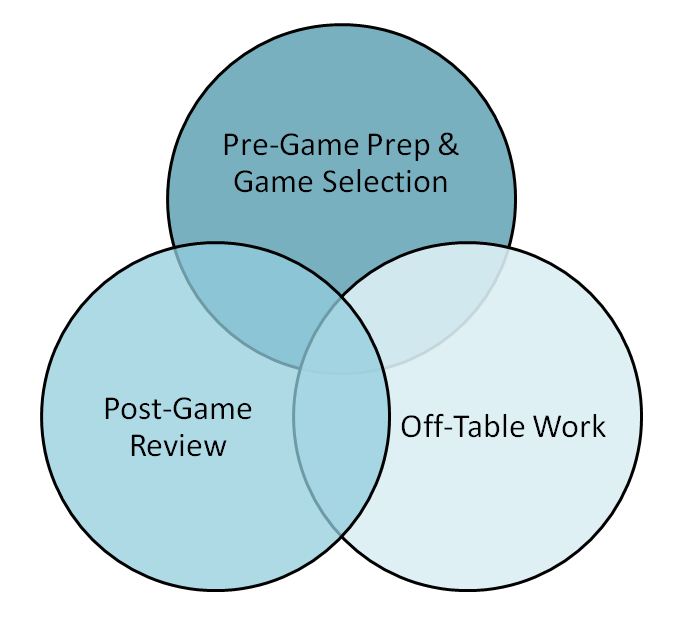
And, finally, preparedness can be thought of as being performed in three distinct phases, or subparts: 1) pregame preparation and game selection; 2) post-game hand and game reviews, including leak plugging; and 3) study & improvement done away from the tables:
The Three Core Phases of Preparation

The more I stare at this breakdown, the more it makes sense. I also believe that this can serve as the framework upon which a player can build his or her own game....

...or at the very least, serve as a starting point for someone else to take these ideas and rework them yet again into their own thoughts and blog posting. We're all in this poker mastery quandary thing together after all, right?

All-in for now...
-Bug
*If you're interested, you can read the original blog post that got me thinking here.
** Note that these three categories (Position/Starting Hand Selection, REDi, and Deception) correspond almost directly with level-1, level-2, and level-3 poker thought/analysis, respectively. Pretty cool, huh?