Uh, right. How do all these confusing names actually help us with categorizing players, especially in the heat of battle... and just as importantly, help us play against them?
Aunt Edna's aside, I personally believe a simpler approach is required. Keep it Simple, Stupid (KISS) is a mantra I try to live and work by, and this definitely goes for player typecasting, too.
For me, a good way to typecast players is actually via a logical/sequential three step process: 1) Initial Stereotyping (if playing live, that is; this step is not really applicable online); 2) PATL categorization; and 3) figuring out the villain's Level of Thought. These three things, especially the latter two, will take you a loooong way toward reading villain's hand range and line. I've already touched on the first and third steps (here and here, respectively) in previous posts. Today, I want to talk a bit about the middle (and perhaps most important) one: PATL charting.
PATL (pronounced like the word "paddle") charting is an abbreviation that stands for Passive-Aggressive/Tight-Loose. The poker author Charley Swain popularized this notion in his ground-breaking book Advanced Degree in Hold'em. For those familiar with HUD programs like PokerTracker and Hold'em Manager, the PA and TL numbers are the first two default stats that get displayed on top of an opponent on the screen (albeit in the reverse order; i.e., Tight-Loose first (VPIP), followed by Passive-Aggressive stat second (PFR)).
PATL is a measure of a) how loose a villain plays; and, b) how aggressively.

We can combine these two graphs into one, and then divide the result up into four standard quadrants (i.e., player classifications):
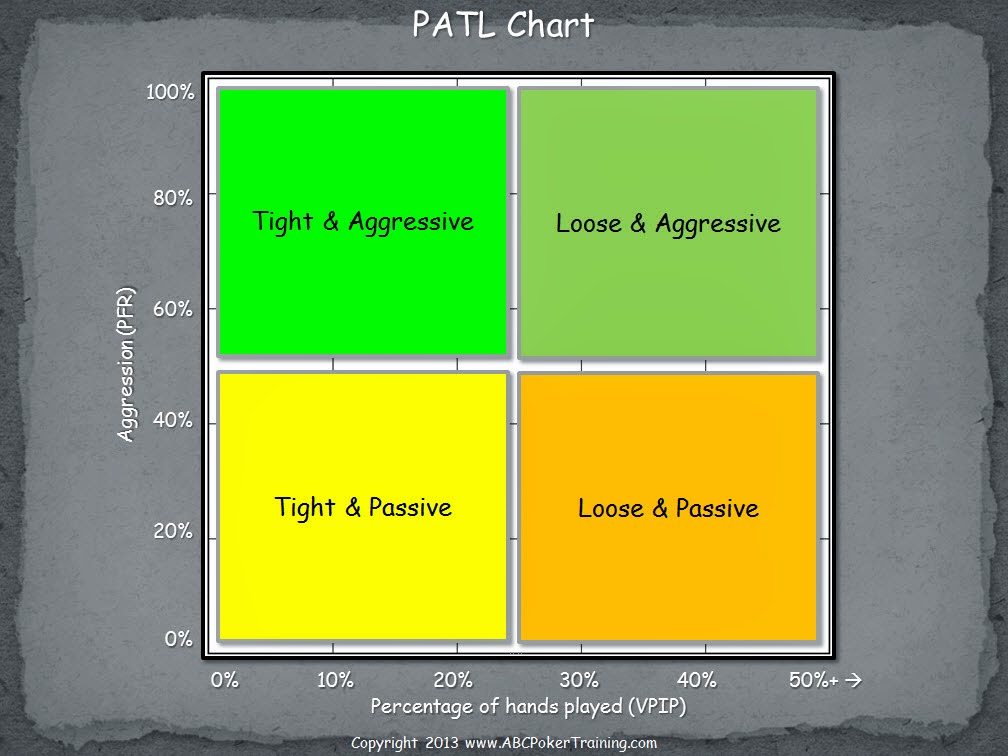
Think of PATL charting as the first major refinement to the initial stereotyping step. The seventy year old cranky codger, for example, is probably pretty loose, playing most Aces and Broadways, suited connectors, unsuited connectors, and pretty much anything shiny and bright. He's also likely to play fairly passively with most of those cards, preferring to see cheap flops and hoping to hit. As we observe his play for the first couple of laps we will probably confirm these general tendencies, so fairly quickly we can assume he's playing greater than 25% of hands and raising significantly less than half of those. As we gather more data on the codger, we can refine and improve upon these numbers, but they slowly but surely will coalesce onto one specific area of the chart.
Similarly, the middle-aged conservative insurance salesman playing poker for the first time in a casino is probably going to be timid entering pots; he'll likely play far less than 25% of hands dealt to him, and also rarely raise with them. We'll call him a Tight-Passive player.
The experienced Asian dragon lady is also probably fairly tight, but she's more solid and probably has an aggressive streak to her; lets assume her initial VPIP is somewhere around 20%, but she's raising significantly more than half of those. We'll call her a Tight-Aggressive (TAg).
And the PokerStars kid is probably looser than the average player, and probably also isn't afraid of the raise button; call him 25% and 70% on the TL and PA scales. We'll label him a Loose-Aggressive, or LAg, player.
There are some special cases worth mentioning-- namely, the maniac, the nit, and the calling station:

The Maniac is essentially a loose-aggressive player on steroids; these players are fairly rare nowadays; i.e., most players understand that this is a losing style of play, and unless the player is drunk or insane, you won't see many of these at your poker table. Similarly, the Nit is a special type of Tight-Passive; these players can sit there for hours, folding hand after hand and not playing anything, waiting for Aces and Kings to show up. And the Calling Station is just a Loose-Passive on steroids (or would that be Xanax?); these players just want to see flops and turns and rivers; they rarely if ever raise, instead being perfectly content to call down with bottom pairs and hopeless long-shot draws.
All that said, the majority of live players we find seated at low stakes NL tables usually fall into the bottom two quadrants (tight-passive and loose-passive). Both of these are commonly referred to as "fish." Online, we see fewer and fewer passive players; most of the players still playing online (i.e., in the USA after Black Friday) have gotten pretty good, learning to adapt to a tight-aggressive (TAg) or loose-aggressive (LAg) style of play.
In the next installment on this topic, I'll discuss how a PATL chart can be used to put a player on an actual hand range... which is the ultimate goal of this process, right? I'll also start to bring in the refining factor of position, and how this does or doesn't affect range. Stay tuned.
---
In other news, I hope everyone had a safe and merry Christmas. Mine was low-key and high-calorie-- just the way I like it! Also got a new Kindle, which I've already loaded up with a handful of poker books and good fiction. Woot!
All-in for now...
-Bug


