Special Bug Pages

Showing posts with label REDi. Show all posts

Saturday, March 7, 2015

Love those a-ha moments...


Did a fun online $0.25/$0.50 6max session/lesson with a student today. We were in mid-position and opened with a pair of eights to $1.40. The action folded to an aggressive recreational player on the button who flat called. Blinds folded. Flop came out 9-2-2 rainbow. We c-bet to roughly 60% of the pot. Villain re-raised us 3x.

My student's immediate instinct was to fold, but before we did I asked what was the villain's preflop range? Remember, they just flatted an MP open raise and we're ~100bb deep. Student's answer: small- and mid-pairs and suited connectors.

So the next question was: Good, so what are you afraid the villain has here? Answer: a nine? Maybe a two? Or an over pair?

Name the deuces that are in his range? Answer: Uh, there's only one pair of deuces.

Good. Now name the nines that are in his range? Answer: There are a few combos of pairs of nines. Or he could have T-9.

And what over pairs are in his range? Answer: Uh, tens?

Really? At this aggro 6max table? Answer: No, he'd probably re-raise us with those pre.

And how many other cards in his range missed this flop? Answer: Uh, a bunch.

So what are you afraid of? Answer: Uh... uh... not much.

Based on his stats, is the villain aggressive post-flop? Answer: Uh, yes.

Does he multi-barrel? Answer: Uh, yes.

So do we have the best hand the vast majority of the time here? Answer: Yes. 

Will he bluff a lot in this situation? Answer: Yes.

So, when we have the best hand against a bluffer, what should we do? Answer: let him bluff.

Good. 

So we called. Turn was a three that completed the rainbow.

So, did this improve villains hand? Answer: No!

So has anything changed? Answer: No!

Do we still have the best hand the majority of the time? Answer: Yes!

Are there any draws we should be afraid of? Answer: No!

Is the villain likely to continue bluffing? Answer: Yes!

So what-- Answer: Let's let him keep bluffing us!

We check. Villain fires another barrel. 

So should we call or raise? Answer: If we call, he'll have about a pot size bet left to bluff again with.

Do you think raising here is going to get worse hands to call? Answer: No.

Do you think he'll fold those few better hands in his range if we raise? Answer: No.

So raising accomplishes what? Answer: Nothing good!

So, what should we do? Answer: Call!

River was another blank. 

Should we--  Answer: Nothing has changed! The only way he can win is to bluff us again. We should check!

We checked, villain shoved, my student snap-called, we doubled up.

A-ha, says the student. A-HA!

All-in for now...
-Bug


Saturday, June 7, 2014

Motley Memphis Miscellania

It's been a very busy week for me at work, so not much time for play or posting. Ergo, here are some miscellaneous bits that have popped in and quickly out of my mind since the last posting (all collected during the week via Evernote (see below)):

---

Trying out a new blog layout to simplify things a bit. Feedback is welcome...

---

Since the demise of PokerStove, which was arguably the most significant and game-changing poker software ever written, us die hard equity geeks have been forced to find other alternatives. Equilab is a good (free) one I use when I want to run multi-way combos, but the one I like the most is  Flopzilla, which has the cool ability to show you graphically how hard you hit a flop with both specific hands and ranges alike. Here's an interesting one, for instance: Holding a pair of eights, you're actually more likely to flop a set than an overpair:


---

Fellow poker blogger Memphis Mojo is currently making a deep run in the Seniors event at this year's WSOP. Run, Memphis, Run!

---

One of the most important things to do when implementing the R-is-for-Reading step of my REDi system is: Look Left. How many people are there left to act? What are their tendencies? How likely are they fight back? What ranges do they reraise and/or cold call with? Do they like to squeeze? What size stacks do they have? What if any tells can you pick up? And so on....  Remember that the upstream action is definitive and fixed and 100% readable, but the downstream action is the big unknown-- and those folks are going to have position on you throughout the hand if you decide to play. Make sure you take the time to assess their intentions before acting yourself.

---

Wow. Got contacted by a pretty serious and talented poker player who wants to watch me play. This person is a known "name" in the poker world. Coincidentally, I also was contacted by the Guru, who also wants to spend some friendly sweat session time with me online. I'm weighing whether I want to really open this particular rabbit hole door or not. Lots of reason both to and not to do this.

---

The CIA has joined the Twitter world this week, and it turns out they have a sense of humor after all. Their first post was: We can neither confirm nor deny this is our first post.  Cute.

---

For the past few years, I've been using Microsoft OneNote to keep all of my notes in life. This includes work, home, personal, project, and of course poker stuff. Unfortunately, I was switched from a PC to a Mac earlier this year, and while there is a Mac version of OneNote available, it's buggy and has some significant limitations. So... I made the switch this week to the other big name in this note-taking business: Evernote. While not perfect, and certainly with its own limitations, Evernote works seamlessly on my new machine and I'm finding the switch not too hard to make. I'd love to hear how you loyal readers take and organize session notes and poker strategy, but if you're struggling I would suggest you look into the (free) Evernote. It works cross platform (Mac, Windows, mobile devices, web-based, etc.), is fairly intuitive to use, and makes keeping, searching, and using collected data and notes pretty easy.

---

All-in for now...
-Bug


Sunday, December 15, 2013

R is for Reading. And Reduction.


Long time readers of this blog know that a few years ago I put together a little system called REDi, which I frequently use to analyze what specific actions one should take in a hand of poker. It's basically a method that breaks down the process of hand evaluation into four discrete steps. The letters R, E, D, and I represent the four discrete steps of Read, Estimate, Decide, and Implement, respectively. Not surprisingly, these four steps also line up with the same basic OODA method (Observe, Orient/Evaluate, Decide, Act) that our military uses for battlefield decision making (poker is war, after all):


The REDi process is simple but effective. We Read our opponents and game situation to determine what probable hands they hold. We then Estimate the strength of our own hand against that range, determine how much if any fold equity we have, and calculate our degree of pot commitment. Once we've done these two things, we Decide on the line we should take in the hand (e.g., bet for value or as a bluff, check for pot control, call on a draw, etc.). Finally, we Implement that decision in a manner that maximizes our expected value (e.g., we determine the largest bet we can make and get called by a worse hand when on a value line, or the smallest bet that can get a better hand to fold when we're bluffing).

For a simple example, let's say we were seated at a full-ring NL game, and a tight break-even ABC player in early position opens for a 3x raise. Effective stacks are 100bb deep. The action folds to us on the button. We have a pair of threes. The blinds to our left don't look interested in the hand and are probably going to fold. What do we do? Answer: employ REDi:
  1. Read. Our opponent is normally tight. He's also a straightforward player, and probably understands position. He's in early position and opening at a full ring table where stacks are fairly deep. Our read is that he has a relatively strong hand. Call it AQ+ and 88+. 
  2. Estimate. Against a strong range like this, our pot equity with a pair of treys is pretty low-- probably around 30%. Similarly, our fold equity is pretty tiny; in fact, he's probably only folding out the bottom of his range if raised. If we call, the stack-to-pot ratio is going to be around 13, so we're not going to be pot committed. With these stacks, we also theoretically have a maximum of ~100/3 = 33:1 implied odds.
  3. Decide. With IOs like this and this type of opponent, this looks like a good situation to set mine. We'll fold on the flop if we don't hit and get bet into. Our line is therefore a one-street draw to a set.
  4. Act. Call.
  5. Repeat 1-4 on Flop, Turn, and River as required.
Got it? Good. Because in today's post, I want to delve a little more deeply into the first and most important of these four REDi steps: Read. Why? Because you cannot win long-term at poker if you're not accurately reading the hand ranges of your opponents, that's why. Let me rephrase for clarity:

Question: How can you possibly decide whether you're ahead (and therefore should take a value line) or behind (and therefore consider taking a bluff or draw line) unless you have accurately read your opponent?
Answer: You can't.

That's right, you can't. You can't estimate your pot or fold equity. You can't make any kind of reasonable line decision. You can't choose an appropriate bet size. In other words, reading, so to speak, is fundamental to making good poker decisions.

As you move up into higher stakes (and therefore play against better opponents) you also need to accurately predict not only the hand range of your opponents, but also what lines they are trying to take. Do they think they have the best hand and are trying to extract value from us, or do they think they're behind and are they trying to bluff us, or are they on a draw, and so on…

So how do we make these kinds of reads? To a beginner, it almost seems like magic when a professional like Negreanu calls out what their opponent has before he or she turns their cards over. I still remember when I was just starting out in poker, watching my own poker coach tell me that a villain he was playing online probably had AQ...and then being amazed when that villain turned over exactly the predicted hand. I was in awe.

Now that I'm a relatively advanced player, this type of hand reading doesn't seem like such mystical magic anymore. In fact, I now know that there is a logical and systematic process to hand reading that can be learned by pretty much anyone willing to do the work. Is this process accurate 100% of the time? No, of course not. But it's nevertheless a pretty damn good approach, and by using it correctly, the majority of time you will be able to put your opponent on a fairly narrow range of hands.

So how does this process work? To answer, the first thing we have to recognize is that hand reading is a reductive process. We start with gross, big picture assumptions, and then as we gather and analyze information, we reduce, or narrow the possible hands our opponent can hold.

I discussed this a little in a previous post via the graphic that showed how we refine our reads by adding in successively more detail and information. This technique is known in engineering and management circles as "progressive elaboration", and it's perfectly applicable to poker, too:


Uh, okay Bug. You showed us this before in a previous post. What's the big deal? Well, for starters, we can take the chart and divide it into two parts that helps further simplify the reading process:


The left side of the chart is where we do basic "typecasting" of the villains we face. This includes gross stereotyping (which I wrote about here), followed by pegging the villain on a "PATL," or Passive-Aggressive vs. Tight-Loose chart, followed by determining the villain's level of thought (i.e., how deeply they think about a poker hand, and how deceptive they are in nature). Said another way, this is a basic categorization of the opponents we face, and it will actually get us a long way toward assigning an eventual hand range to the opp. We aren't actually trying to put our opponent on a very specific range of hands at this stage, but instead are mostly thinking in broader terms about the types of hands he or she plays, as well as a general assessment of the style of play they employ when playing poker.

This first typecasting step is crucial for two reasons: a) it helps us determine basic strategies to employ immediately against the opponent (such as whether we should try stealing their blinds or not if it folds to us on the button, or whether continuation betting will be effective or not on a disconnected board); and b) it helps us perform the second step to hand reading, where we will really start narrowing down the range of possible hands....

...which brings us to the second, right-hand side of the chart, which is known as "range reduction." This is the time in which we put our opponent on a specific hand range and line, and then narrow it as the hand progresses and we learn more. We start with the typecasting information we've gathered on our opponent, and then we factor in specific things such as our board texture, the opponent's statistics, combinatorics and dead cards, bet sizing, villain second order stats, tells, meta-game factors like tilt and wins, leveling, and so on...

...and by the time we're at the river we can often narrow the possible hands our opponent holds to just a few cards. We can, in effect, predict that proverbial AQ and amaze our friends and family.

And make a lot of money, too. :-)

To repeat, hand reading is a reductive process; we start wide, and then take away from, or reduce, the range of cards our opponent could have as we add in information we collect. Our method is to reduce and simplify, reduce and simplify, reduce and....

In my next post on this subject, I'll discuss a bit more about the typecasting process.

All-in for now...
-Bug

Friday, September 6, 2013

Peyton's Poker Place

If he ever set his mind to learning the game, I believe Peyton Manning would make a formidable poker player. Witness his dismantling of last year's Superbowl champions in Thursday's NFL season opener. Let me explain.


Great poker players observe, analyze, and adapt. They pay attention to how the opp is playing, they make tactical adjustments, and then they exploit the mistakes and weaknesses of the other side. They also choose their battles and their opponents. Villain 1 is playing weak-tight, so I'm going after his blinds. Okay, he's pushing back now, so I need to start tightening up myself. Villain 2 is super solid, so I'm not going to try to outplay him. Villain 3 is isolating Villain 1 with weak hands, so I'm going to start re-iso'ing him light. And so on.

This is exactly what Peyton did last night. The Broncos were actually behind in the first half, but you could literally watch Peyton remain unfazed, working on the field and on the sidelines observing and analyzing during this period.  He was masterfully figuring out how the opp was playing, choosing which defenders to go after and which to avoid, deciding on specific tactics against each, and so on.... and then he just plain took apart the Ravens, piece by piece, in the second half. Holy cow was that an amazing poker game played on the field. Read, Estimate, Decide, Implement... over and over.

I'm not a Bronco's fan by any stretch of the imagination, but damn is their quarterback good. I bet he would be equally good on the felt.

All-in for now...
-Bug


Friday, August 17, 2012

AQs Cash Hand Quiz Question

I've been fan of the Daily Quiz of the Day website for years. On average, they post more tournament than cash game questions, so as I prep for next year's WSOP I will probably be spending even more time on their web page every morning than I usually do. (You can find a link to the site in the "Resources" tab at the top of this blog's home page.)

Anyway, today's question was a fairly standard cash game Q, but it got me thinking afterward that this is a common hand that a lot of newbies lose unnecessary money on, so it bears a little scrutiny. Here's today's question via a cut and paste from their website:


So what do you do? A beginner (or even an intermediate on autopilot) might see what looks like a strongish hand, then glance at the low effective stack size and just get it in. An advanced player would take the time to do REDi:

Read: what range do we put our opponent on? He’s been laggy a lot preflop, but for 5x size raises. Here he jumps in with a 10x raise from UTG. We don’t have to worry about anyone else in the hand, as we’re in the BB. The 10x raise is weird; either it’s a very strong hand, or one he doesn’t want to see any action with. In low-stakes games I frequent, the latter is often indicative of hands like JJ or TT from a bad player. Sometimes you see people turn up AA, KK, or AK here too.

Estimate: against the stronger part of villain's range, our AQs is 2:1 dog or worse. Against a range of middle pairs, we’re at best a coin flip. We have essentially no fold equity, as he’ll be getting good pot odds to call a shove with his short remaining stack. The only real thing working in your favor is that the SPR is low; in other words, you don’t stand to lose too much with the hand.

Decide: Our hand doesn’t have much if any Value against the opps range, and we essentially don’t have any fold equity, so Semibluffing is no good. In other words, pushing is out. Calling to see a flop is not much better, as we’ll be OOP and essentially in the same boat we’re in now (i.e., confused as to where we stand). Therefore this is an easy fold.

Implement: Muck.

All-in for now...
-Bug

Saturday, June 30, 2012

Poker is War


I'm reading a really interesting non-poker book during some of my downtime on vacation. The book is One Bullet Away: The Making of a Marine Officer, by Nathaniel Fick, and it describes how Fick went through officer candidate school and beyond, and then really learned about leading men during the second Gulf war, when he was given a recon platoon to lead against the Iraqi Army.

So what's this have to do with poker? Not much, really, but something caught my eye today when I read about the training they did in Kuwait during the run up to hostilities. To hone their skills and reactions to different scenarios, the platoon drilled using a method called OODA, which stands for Observe, Orient, Decide, Act. The method was developed by an Air Force colonel to help address unexpected strategic and tactical situations during battle. It's still used in the military, but it's been adopted by business and civic leaders as well.

Observe, Orient, Decide, Act.

Sound familiar?

Observe = Read. Orient = Estimate. Decide = Decide. Act = Implement.

OODA = REDi.

I've (re)invented a technique for analyzing war situations. Oh, and poker, too. Kind of.

All-in for now...
-Bug

Saturday, March 24, 2012

Check Your Ego at the Door


There's a lot going on in his this hand--some good, some bad--but the thing I want to point out takes place at 8:19 in the video. Phil the Duck has a very weak pair on a highly coordinated board.

By the time they get to the river, you can see Hellmuth really struggling with the correct play (fold) versus what his ego is screaming at him to do (make the hero call). IMHO, this is the Duck's fundamental problem in cash games: his ego. This is made abundantly clear at 8:19 when he says to himself, "I'm going to look like an idiot if I'm wrong. I'm going to look like a genius if I'm right."

Who the hell cares what you're going to look like. Why are you even having these thoughts? You should be REDi'ing your way to a fold. Instead, a significant part of your avian brain is literally worried how you're going to look to the TV audience. Seriously.

Yes, it's Dwan. And yes, he could be doing this with a very wide range, including air. But come on, already. Do the right thing.

The lesson for the rest of us is: Check your ego at the door and play REDi-poker, not vanity-poker.

All-in for now...
-Bug

Thursday, March 22, 2012

X-Ray Poker

A preflop question you face on every new deal in Hold'em is whether you continue in the hand or not. Then you have to answer this same question on the flop, the turn, and the river. So how do we decide whether we should continue or fold on each of these betting streets? Is there a systematic means of evaluating your situation and determining whether—and how—to play your hand?

The answer of course is Yes.  To understand how this process might work, let’s pretend for a minute that you have a poker superpower: X-ray vision. You can see what cards your opponent holds hidden in his or her hand. Imagine how easy poker would be with this ability!

For example, let’s pretend that you are dealt a pair of Kings in middle-late position. People start folding in EP, so you are preparing to open-raise when the action gets to you. Ah, but a fairly inexperienced player immediately to your right open-raises instead. When you peer at his hand with your X-ray vision, you see that he has been dealt two Aces. You then look to your left and see that your opponents all have bad cards and are going to fold.

Your Kings are dominated by the Aces, so you consider folding and moving on to the next hand. But you decide a better strategy might be to just call the villain’s bet, with the hope of you hitting a third King on the flop. There is approximately a one in eight chance of hitting a King (actually 7.5 to 1, or one out of every 8.5 times). This is obviously not a very big chance, but your opponent has a giant stack of chips in front of him, is inexperienced, and he likely will pay you off with most or all of them if you do hit a King.

Many beginning players fall in love with their big pairs like Aces, and if your set of Kings is disguised, he will probably think he still has the best hand after the flop, and will be willing to commit all of his chips. If you don’t hit your King on the flop, however, you can easily fold and move on. You will invest a relatively small amount of money before the flop with the hope of hitting your hand; if you don’t hit, you can fold. If you do hit, you can win a large amount.

Said another way, you know exactly where you stand in the hand relative to your opponent’s cards, and then you can make the perfect postflop decisions and actions based on this information.

Whether you realize it or not, what you’ve done in this hand can be broken down into four distinct steps, which are Read, Estimate, Decide, and Implement. In this specific hand, the first thing you did was “Read” your opponents’ hands (via your X-ray vision). You put the villain on your right on a pair of Aces, which he undoubtedly liked very much, and you put the other players left to act on weak hands that they were likely going to fold.

Second, you “Estimated” how strong your Kings were compared to the villain’s Aces (answer: not very strong preflop), how much money you have to invest in the hand to hit a King (answer: the amount that he raised, which is a modestly small amount compared to the stack sizes), how likely it is you’ll hit one of the two remaining Kings on the flop (answer: one out of every 8.5 times), and how much money you could win if you do (answer: the villain’s entire stack).

Third, you “Decided” on a speculative course of action that could potentially pay off big; i.e., you decided to  draw, or set mine in and effort to hit one of the two remaining Kings in the deck. You also decided to fold if you didn’t hit your set.

Fourth and finally, you “Implemented” this draw in a way that minimized your loss (if you didn’t hit a King) and maximized your potential profit (if you did hit your King). You also implemented it in a way that disguised your hand (the majority of people reraise with Kings). You did this by just calling your opponent’s raise preflop.

In other words, you Read, Estimated, Decided, and Implemented. These four steps—Read, Estimate, Decide, Implement—is how professional poker players are able to make such sound decisions at a poker table; they use techniques and thought processes like REDi to logically work through the best course of action for their current situation. This in turn maximizes their profit and minimizes losses.

All-in for now...
-Bug
PS. Obviously, this was an extreme (actually absurd) example. We don’t have X-ray vision, so making perfect reads is essentially impossible. We can, however, make educated assumptions and approximate reads on our opponent to narrow down their range of possible holdings, and this is usually sufficient as a "Read."  For instance, instead of Kings, we might have been dealt a hand like Eights. Further, we wouldn't have been able to put our opponent exactly on Aces, but we might have put him on a range like TT-AA, AQs, and AKo+. We would have then been able to carry out the other three steps (EDi) in essentially the same manner, and probably arrived at the same exact Implementation. REDi is how this is done.

Thursday, March 8, 2012

Big > Small

A question sent in by a reader:

"You have QQ in BB. Folded around to the button who raises to $2.00 You and villain both have $95. You have no information on your opponent, 9-handed, game is solid. Do you?
  1. RR
  2. Call
You actually RR to $5.00 and the Villain calls. The flop comes 3-8-9 rainbow. You lead with a standard $7.00 Bet.Villain raises to $18.00 What do you do?

Preflop:
  • Reads: It was not stated, but given the stack sizes, I assume this is a $0.50/$1 game. The game is also said to be "solid" which implies the unknown villain is therefore a solid, level-2 or higher TAg player. Let's further assume that he thinks the same of us.Villain's min raise on the button is definitely small. If he's the good player we think he is, he's either doing this because it thinks he can steal this cheaply against us (which is doubtful, given that he also knows very little about us), or that he has a pretty good hand and wants action. Initial range is 88+, AQs+, some of the bigger broadway SCs, and the like. I'm a cautious "low variance" person by nature, so I'll assume he likes his hand.
  • Estimate: Against this range, our QQ is around a 60:40 favorite.
  • Decide: We've got solid Value.
  • Implement: We're ahead, but we're also going to be OOP with a vulnerable hand. Calling OOP with a 60:40 hand is dumb when 100bb deep, as you're going to get in trouble if an A or K or coordinated board hits. Reraising is the right play. The reader chose the right line, but the execution was poor. A $5 reraise is too small. Why? First, you have a value hand so you want to build a pot. Five dollars is not going to allow stacks into the middle by the river if your hand remains strong and the action goes bet/call through fifth street. Second, to a solid L2 villain at $100NL, this tiny blind reraise screams that you've got a big hand and want action.  And third, betting this small mathematically prices in many of the villain's drawier "bust'em" hands. I would suggest a bump to at least $7.50 or higher.
Flop:
  • Reads 1: Villain's cold call of our $5 RR doesn't eliminate anything except AQ or maybe AK from his range. The big question is whether we can eliminate KK+ or not. The majority of ABC players in the micros are going to 4bet us pre with cowboys and rockets. The question, of course, is whether this player is ABC or not. I don't think we have enough info to go broke with yet, so I think we have to leave these hands into his range. Further, at the $100NL and up, players tend to get trickier IP with these big hands facing 3bets. Ergo, let's keep our range at something like 88+ and JTs-KQs.
  • Read 2: the flop is rainbow and no flushes are possible. The 8-9 part of the flop, however, hits the connector part and the lower pairs of the villains range. Our lead of $7 is again too small into the $11 pot when the flop connects with the bust'em/draw part of our villain's range. I'd like to see at least $8.50 or more. In any case, the villain repops us, and he also does so on the small side. With flopped sets, he's probably going to let us hang ourselves on a later street (given that he's put us on a big hand), but that's not a certainty. He knows that you know the flop has straight draws that connect to his range, and he knows you'll try to protect with the cbet. He's also put you on a strong over-pair kind of hand. Him reraising here with 88 or 99 is not crazy, but it's somewhat less likely than him doing this with KK+. He could be doing this reraise with the JT part of his range on a semi-bluff, but the his sizing seems suspect (i.e., low).
  • Estimate: Given the board texture and the villains smallish reraise, I think we've gone from a favorite to even money at best. If we leave in 88 and 99 in his range, in fact, we're now a dog at 45:55. For now, however, let's call it a generous 50:50.
  • Decide: Our hand went from solid value to basically break even in the blink of an eye. We're OOP with just an overpair against an opponent that has a range that connects with this board as a draw and/or is ahead of us. Further, if you reraise here, it has to be to at least $40 or so, which means you're pot committed. So ask yourself: why would you reraise? Value? Nope, you're even money. Bluff? Nope, he's folding out his worse hands, and he's only going to call with hands that crush you. Finally, do you want to go broke with a one pair hand? You might argue that you have showdown value here, but I think you're actually on a marginal fold line.
  • Implement: Fold.
Lessons:

  • Lesson 1: Reader needs work a bit on bet sizing. At best, the small bets feel like FPS. At worst, they make your own hand very easy to read and don't accomplish anything very effectively (build a pot with value or put pressure on to fold out better hands).
  • Lesson 2: Reader needs to actively put his opponents on ranges. Nowhere in the original problem statement was there made any mention of hand ranges of the villain. It feels way too much like "We has Queens! We gotta be ahead! Let's get trappy!"
  • Lesson 3: Queens always look so damn sexy when you're dealt them, but they can fall from grace very quickly on so many different flopped boards.
  • Lesson 4: Don't go broke with an overpair in NL cash games.

All-in for now...
-Bug

Monday, February 27, 2012

Trying Another Approach...

I have been in a email discussion recently with a friend about poker quiz question #48, in which I said that the correct answer was to fold AKo preflop. My friend thinks that calling is a better option. We've gone back and forth a bit, but neither seems to be making any headway with the other. Don't worry, I won't get into a rehash of our debate here, nor will I repeat my original long-winded analysis of the hand (you can read it at this link here if you want). Instead, I'd like try another approach to arrive at a logical decision in the hand. In my last blog post, I showed a basic flowchart to help simplify poker decisions. Here it is again:


So I woke up this morning and figured, "what the heck?" Why not give this a try with Q#48 and see where it leads:

We've seen a raise and then a re-raise from two TAgs. The action is to us and we've been bet into. So we choose the YES path in the flowchart. This leads us to:


This one is a little tricky, and it depends entirely on the range we assign our opponents. Heads-up against TAg #1's range, we're ahead. But against the heads-up 3bet range we assigned TAg#2, our equity is only 45% to his 55%. And against both players, our equity is just 30%. So, by definition, our hand is not likely the best. In our email exchange, my friend actually assigned the range of TT-QQ to TAg#2, and against this range, our AK is crushed even further at just 28% to the villain's 72%. Therefore we take the NO fork in the road. This leads to:


Again, if our equity is 30% against the assigned ranges, but we're getting 33% to call (assuming we don't get reraised by TAg#1), the math says we're not even break-even by calling. The situation is worse if we assign my friend's TT-QQ range. Therefore the correct path to take here is again NO. This leads us to:


I believe the answer here is also clearly no. Why? Well, it goes back to the ranges we put on our opponents. For example, if TAg#2 has 99-QQ and an Ace or King hits on the flop, he's not going to pay us off. If he has AA or KK, we're in an RIO situation. If he has AQ we will get paid off only if an Ace hits, but not if a King hits. If he has AK, we're chopping. In other words, we have essentially no implied odds against this guy. The same type of analysis can be applied to TAg#1. Therefore we have to take the NO path again, which leads us to:


Against TAg#1, you might argue that you have decent fold equity, but there are two opponents involved. I.e., we still have to get past TAg#2. Given his range and the fact that he knows we'll be OOP in the hand, we're probably only getting him to fold out a small part of his range, and in fact it will be those hands that we don't want him to fold. The rest of his range (that's currently beating us) he's either calling or 5betting with. Therefore we take the NO path one again, which leads to:


Quod erat demonstrandum.
All-in for now...
-Bug

Sunday, February 26, 2012

Great Minds Think Alike

What has been will be again, what has been done will be done again; 
there is nothing new under the sun. 
--Ecclesiastes 1:9

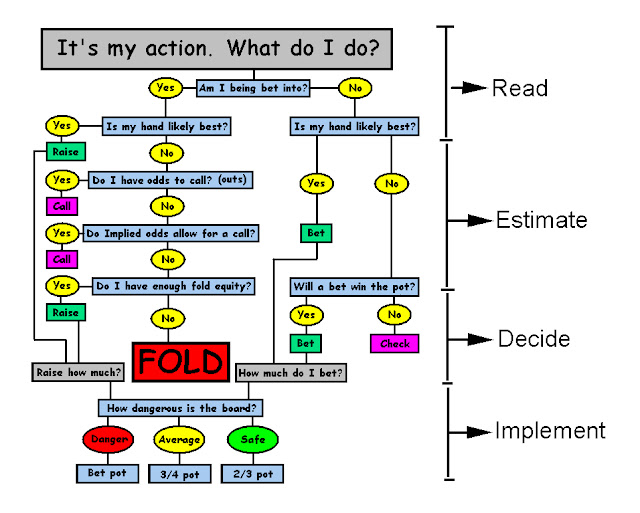
I was surfing the archives section of the 2+2 forums last night and stumbled upon a neat little flowchart of how to play a poker hand. The guy who long ago created this flowchart had evidently done so in an effort to teach his girlfriend how to play poker. He wanted a means of simplifying her thought/decision process on each street of a hand, and this is what he came up with:


My first thought when seeing this chart was, "hey, this is pretty cool!"

My second thought, however, was, "hey, wait a minute! This is a simplified version of my REDi system. He's just put it into flowchart form!"

In other words, I can (almost) overlay REDi directly on top of the flowchart process:
Granted, the flowchart is pretty simplistic, and wouldn't work very well in a tough game with L2 or above thinking opponents. It ignores some key things like Reading your position, board texture, your own image, and so forth. It also misses the key step of Estimating your pot commitment level. There are also a bunch of advanced lines and implementation strategies like check-raising, semi-bluffing, floating, inducing bluffs, and the like that are left out...

.... but, honestly, for a beginner, this is actually a pretty good way to think about a poker hand and arrive at a reasonable decision.

So, my third thought was a repeat of my first one: "hey, this is pretty cool!"

They say that there are no new original thoughts, just original people rediscovering and reorganizing things to fit their own world view. I suppose this is just another example of that notion in action. Pretty cool, indeed.

All-in for now...
-Bug

Saturday, February 18, 2012

Melted Glaciers

Well, my tournament life in the WRGPT "glaciers" poker-by-email tournament has come to a crashing, ignominious end. I've been nursing a small stack for the last couple of months, waiting for an opportunity to chip up. Alas, I've had (a) some big stack bullies running over the table; and (b) zero playable cards or get-it-in opportunities arise for a while. On Wednesday, however, I finally picked up a playable hand in middle/late position. Here's what happened:

Blinds were T600/T1200 with T200 antes. I had T22K, so my M was getting pretty low. I picked up K-T♦ in mid/late position. Most everyone at the table had me well covered. I considered just open shoving, but I went with a 3.5x raise instead. In hindsight, I think this was a mistake; I should have just shoved then and there, and taken down the blinds and antes. C'est la vie.

Anyway, I got cold-called by a big-stack bully to my left, and then also by the two blinds. All three players had me well covered by at least a factor of two. The blinds had both been playing fit-or-fold poker. The one player who was to my left was relatively new to the table, so I didn't have any good reads on him. He had me covered by a factor of six.

Flop hit me pretty strongly and was also fairly dry: 6-8♠-8. While I didn't flop a made hand, I did have two overs and the second nut flush draw. The paired board did give me some pause, but from a combinatorics point of view it was very unlikely one of my opponents held an eight. I was concerned about someone holding a six, but even if that was true I had reasonably good equity.

The two blinds checked and the action was to me. At this point, I went into full REDi mode, including a review of the situation with Mr. Mulit. Here's what I was thinking:

Reads:
The other three players like to see flops. The big blind is playing fit-or-fold, the other two are playing big stack bullies. Can’t really put any of them on big pairs, as they probably are the types to repop pre. I’m therefore thinking small or middle pairs, overcards, or maybe some SCs.

Estimate:
Hand Equity: per ‘stove, I’m a 37:21:21:21 favorite against all three if I assign them each the above range.
Fold Equity: FE is reasonable against the two guys who have ~2-3x my stack size, very little against the big stack on my left, who has me covered 6x.
Commitment: My M is five if I fold here; getting desperate.

Decide:
 I’m not 100% pot committed, but with my M this low, I have to make a play soon. If I double up here, I’m back in the game. If I decide to check/fold, I’m still semi-alive, but my M is so low that I need to play another hand soon. I've got lots of outs, therefore I think my best line here is semi-bluff.

Implement:
With an M this low, the only viable way to semi-bluff is to Jam (and pray).

So I shove... and get insta-called by the knucklehead to my left, who turns over 5♠-6. Seriously. Both blinds fold.

Turn is J♦. River is 8♣.

I hit my flush, but the villain wins with the ugly rivered full house.

The good news is that REDi  led me to the right decision. The bad news is that the cards didn't cooperate...

Oh well, I'll just hurry up and sign up for the next Glaciers tourney..... in October. Sigh.

----
In other poker news, if you haven't already watched Daniel Negreanu's latest vlog, I encourage you to do so. Specifically, the fun starts around 5:56 into the video, when Daniel goes off (again) on the pond scum otherwise known as Howard "the Professor" Lederer, Ray Bitar, and Chris "Jesus" Ferguson. Watch the youtube video by clicking HERE.

All-in for now...
-Bug

Tuesday, February 14, 2012

Barking Mad Differences of Opinion


I had an interesting conversation yesterday with a poker playing friend (who shall remain nameless). In the conversation, this friend remarked on a number of things I've blogged about lately, including the weekly Poker Quiz Question installments and my REDi system. In both cases, my friend felt I've missed the mark and/or have misrepresented myself and/or am overly complicating my approach to poker. His comments bothered me for most of the rest of the day, so I'm here to set a few things straight for the record.

First off, my friend seemed doubtful that I actually created the Read-Estimate-Decide-Implement (REDi) system all by myself. I surely must have cribbed this from somewhere, right? To this, all I can say is believe what you want; REDi is all mine. Google it and see what you find. Did I create it in a vacuum? Of course not. Essentially nothing man made in this modern world is created out of whole cloth. REDi has heavy influences from Sklansky's fundamental theorem of poker, Harrington's series on cash games, James "splitsuit" Sweeney's concept of lines, and of course Mehta/Flynn/Miller's writings on stack-to-pot ratios and their Range/Equity/Maximize technique.

A year or so ago, I took all this information and spent a few months chewing it over in my head, looking for and deriving REDi (originally called RED-M) as a systematic approach to deciding on the proper line to take in any given poker situation. I did this because I had concluded that essentially all modern poker books ignore this process. Sure, poker authors teach people how to calculate pot odds, and how important position is, and sometimes even give you some starting hand charts to kick start your game, but essentially nobody actually tells a beginner how to logically think about a poker hand. What is it you're actually trying to achieve? What matters in a hand, and what doesn't? What kind of logical steps should a beginner start with when facing a tough situation? Hell, what about even easy situations? It's all too facile to say raise KJ in LP when no one has entered the pot upstream of you, but fold if there's been a raise. But why is this so? And what happens if there are maniacs still left to act? What if they're nits? And so on... I.e., what is a pro thinking about in this situation that an amateur doesn't understand? Why does a pro call with one hand, raise in a seemingly identical situation a few hands later, and fold in another? The purpose of REDi is to offer up a process that a beginner can use to begin thinking logically about a hand. Is REDi perfect? Absolutely not. Is it good enough? Yeah, I actually kinda think so. 'Nuff said.

Anyway, my friend also pointed out that posting the Quiz Questions is a waste of time. I should cease and desist, mostly because most of my answers are entirely overly complicated. He implied that posting these long-winded explanations and analyses of poker hands do more harm than good to a newbie. He brought up a recent quiz question in which the answer I arrived at (via REDi) was fold. He said that folding was the obvious answer and didn't need such a complex derivation on my part. I think what he was saying is that one should just be able to read the question and intuitively know the correct answer. If you don't know, you will only really learn by trial and error. In a sense, if you get the wrong answer, over time you will be punished enough (by losing) to understand in your gut that it was the incorrect play. Similarly, if the play was correct, you will, over time, be rewarded enough to reinforce the right play.

Uh, okay. I personally hate learning like this. It feels too much like shock therapy. Worse, because poker occasionally rewards poor play and decisions, you occasionally get a cookie as a result of making the wrong play. Imagine training your dog this way. He urinates on the living room rug. Eight-five percent of the time you whack him with a rolled up newspaper and say, "bad dog." The other fifteen percent of the time, however, you give him a dog biscuit and pat him on the head. Sure, after a few hundred beatings, the dog will probably figure it out. But don't you think there's a more efficient way to learn? I do.

There are many different ways to play poker. Active vs. reactive; strong vs. weak; loose vs. tight; and so on. Are any of these superior to the next? Not necessarily; there is more than one way to skin a poker cat. In a similar manner, I also believe there are different ways to think about poker. Some people (my friend, for example) are highly intuitive. They've learned how to win at poker by sheer brute force, playing a million hands, and, in a sense, pattern matching situations to the correct responses. This is fine, but it's not for everyone.  I, for instance, am someone who thrives on organization and logical process; I'm terrible at "pattern matching" solutions. I don't just want to know what to do in a given situation, I want to know why and how. This is because no two poker situations are identical, and I'd like to have a system in my back pocket that I can use to analyze any individual situation to arrive at the most plus-EV decision and line....

...okay, enough of that little soapbox. To get things back onto a less contentious footing, here's a video my son sent me that points out another type of differences in player types: gamblers vs. EV guys:


All-in for now...
-Bug


Tuesday, June 28, 2011

Lather, Rinse, Repeat: The Flow(chart) of a Poker Hand

Son: "How long does it take to learn poker?"
Dad: "All your life, son. All your life."

Too many players seem to go into a poker hand without a systematic means of evaluating where they're at or what they're trying to accomplish. Said another way, a large majority of players don't really consider a plan when they enter a pot. Instead, it's almost as if they think "Hey, I like these two Broadway cards. They're shiny and pretty. Let's limp in... oh, I got raised. Hmmm. Guess I'll call and hope to hit.... oh, I didn't hit... maybe I'll peel the turn and see where I'm at there....okay, I hit my Jack. Sweet. I'm gonna donk.... oh crap, I got re-raised. WTF? It's only a few bucks more to call.... hmmmm. Guess I'm gonna ship it in and see the river.... damn it! Why does the other guy always have a better hand than me? I hate poker..... Ooh, look! I've been dealt two shiny Broadway cards again. Sweet!"

If you're one of these people, don't fret. We've all been there. The goal is to move out of this (non) way of thinking and progress into actual logical, systematic thought. Most pros have graduated from being a "monkey pounding on a keyboard" to a more logical, systematic type of poker. Said another way, the pros who make a living at poker approach every hand of poker with an actual plan and process.

But what is this plan? How does one go about systematically working through a hand and deciding on a course of logical action? What is the process to follow?

Lately, I've been thinking about this whole hand "process" in my (highly limited) spare time. Specifically, I'm trying to formulate a simple "flow chart" of actions that a poker player should step through when playing.  My goal is to create a framework that a beginning poker player can follow that will (1) help them get up to speed and playing well quickly; and (2) serve as a foundation upon which they can build as their skills grow and they progress into more advanced play. In other words, I'm trying to figure out the fundamental steps that a winning player--whether they are Level 1, 2, or 3--should go through in their mind during the play of a hand. I'm also trying to expand this beyond just the play of a hand; i.e., what is the process one goes through during an entire game or session playing poker? And what what should be the process as you step back further and look at a year (or entire career) spent playing poker.

Yes, this is a tall, tall order. But it's instructive to think about, and I believe it can actually be a useful tool when I'm finished. Now, I'm not finished by any matter, but here is what I've got thus far for the process a professional player goes through when he plays a hand of poker:
I'm going to try to find time to expand on each of the process steps in later blog posts. For now, here's the Cliffs Notes version:
  1. Make Reads. The name of the game here is to read the current game and hand situation. What does this mean? Well, a lot, actually. For L1 players, Making Reads means reading the basic board texture and then evaluating your hand against/with it. You can also begin applying concepts such as "that guy is a maniac. I need to tighten up and play a smaller range of hands against him." As you progress to L2 poker and beyond, this Make Reads step means evaluating the upstream action in a hand, reading probable downstream actions, looking at board and game texture, etc, and then assigning a hand range to your opponents. When you get to L3 poker, you add in things like how your opponent sees you as a player and how they see the other players at the table. The goal here again is to put your opponents on a logical range of hands, and then narrow it down as the hand progresses. 
  2. Estimate Odds, Equity, and Commitment. Once you have put your opponent on a range of hands, the next step is to evaluate your own hand and situation against that range. Are you getting sufficient pot odds to continue? What is your hand strength/equity against the opps' range(s)? What is your fold equity against the opp? Are you pot committed? Do you want to be pot committed?
  3. Decide on a Line. Once you've decided how your hand fairs against the opponents range of hands, the next step is to decide what you want to achieve with the hand. Mr. Multi calls this step "deciding what story you're going to tell." I think of it as choosing a line. I believe that there are really only five basic lines you can take: Value, Show-Down-Value (SDV), Bluff, Draw, and Fold. (Yes, astute readers will realize that there are other "lines" you can take. For example "semi-bluff" or "isolate," but these are really just subcategories of, or shades of gray between the five aforementioned basic lines.
  4. Implement Line. Once you've decided on a line to take, the last step in the process is to implement it in such a way that it maximizes your expected value. Again, there are really only five different ways to implement your chosen line: check, call, bet, raise, or fold. If you decide to bet or raise, this step also includes determining how much to bet. The goal during this step is to implement the chosen line in such a way as it maximizes your EV.
Once you've gone through these four steps preflop, the next step is to repeat them on the flop, the turn, and the river. In each step of the process on subsequent streets, the goal is not to make big changes to your plan, but rather to tweak and adjust. For instance, preflop you may have put your opponent on a wide range of hands, but on the flop the goal isn't to put him on a different range. Instead, the goal is to narrow the original range down to a subset of the preflop range. Similarly, once you've chose a line to take, the goal is to make tweaks to the existing line, and not (usually) abandon the original line altogether. As Mr. Multi likes to say, you have to keep the story line consistent. There are exceptions to this, of course, such as turning a made hand into a bluff on the river, but generally speaking, once you've settled on a "story" you need to keep telling it unless/until something drastic makes you change your thinking.

Okay, so that's how you play a single hand of poker. If we step back then and look at how you play an entire game or session of poker, professionals tend to exercise the following process:
Again, the Cliffs Notes version is:

  • Play Hand. This is just the Make Reads, Calculate Odds/Equity/Commitment, Choose Line, Implement Line process we talked about above.
  • Adjust. This is where we do things like balance our ranges and adjust our play based on how the opp is playing and adjusting to us, meta-game effects, seat changes, table size changes, people going on/off tilt, etc.

And finally, if we step back even further and look at an entire year (or even lifetime) playing poker, the professional player's "poker life" process looks something like this:
And the Cliffs Notes version of this process:

  1. PreGame Prep. This represents us doing such things as exercising proper game selection, seat selection, sizing up games, bankroll management, and preparing ahead of the game to be ready to play.
  2. Game/Session. This just represents the Play Hand and Adjust Game/Session process shown above.
  3. PostGame Review. Here we do things like post-mortems, hand reviews, keep records of our play, and try to find our leaks and figure out how to plug them for next time.
  4. Off-Table Work. This is all the off-table stuff that increases your skills, knowledge, and ability to play. I include things like studying, blogging, reading poker books, watching videos, setting up and mastering HUD and stats collection software, physical exercise, working on anti-tilt measures, etc. Poker strategy discussion groups also fall into this category, as do reading forums (and posting), and just plain talking poker with other enthusiasts. The purpose of this step is really just to ensure we're thinking about--and improving--our fundamentals when we're away from the table and have time to do it right.

Unfortunately, I'm out of time for now, but I'll be back. Again, and again, in a loop.

All-in for now...
-Bug