Special Bug Pages

Showing posts with label tilt. Show all posts

Sunday, April 12, 2015

Revisiting the 3 Edges of Poker Mastery

There are three equally important keys to mastering poker

[Note: Yes, I've written on this topic before before, but a series of email exchanges with a struggling poker player who contacted me through the blog has brought this whole idea back to the front burner. Even if you remember my past posts on this subject, it still bears a second look...] 

There are three major categories of skills, or “edges,” you have to master to win at poker. Of course each of these are comprised of dozens or more sub-lessons, specific skills, and individual tactics to learn, but when viewed from 30,000 feet, poker mastery really does boil down to three, equally important categories of edge. Get these three things down, and you will crush the game. Don’t, and you won’t.

Let’s look briefly at each of the three edge categories:
  1. Off-Table Work. First is the idea that learning poker requires significant off-table preparation and work. It takes discipline. It takes effort—active effort. You cannot just sit back and passively watch a weekly World Poker Tour (WPT) television broadcast on Sunday night and then expect to win at the casino on Monday. It doesn’t work that way. Winning takes commitment and effort. If you truly want to get better—and make long-term, consistent money at the game—then you have to treat poker like you would if you were trying to get better at any other skill-based endeavor, like golf or chess. In other words: study, preparation, practice, and post-game review. No, let me re-phrase that: active study, committed preparation, disciplined practice, and focused post-game review. You won’t get better at golf by cracking a beer and watching the Masters on television; you have to go to the range, work on our swing, hit thousands of balls on the putting green, practice bunker shots, and so on. Simply watching Bubba Watson hit magically bending shots over and around trees isn’t going to somehow turn you into the next Bubba. Same for poker. Watching Phil Laak, Phil Hellmuth, Phil Gordon, or Phil Galfond on TV isn’t going to turn you into the next Phil. The majority of winning poker professionals queried say they had to put in roughly an hour of off-table work for every hour they actually played the game when they were first starting out. Many of these same pros continue that one-to-one ratio even today. They understand that their competition is doing the same, so to keep up with—and surpass—those other players requires the pros to put in the off-table work, including note and record taking, pre-game warm-ups, post-game reviews, leak-finding and plugging, adhering to proper bankroll management, targeted game selection, mental and physical preparation, and discussing and dissecting poker strategy with like-minded serious students of the game. To get better, you have to actually work at it away from the tables. ‘Nuff said.
  2. On-Table Technical Skills. The second major edge category is the ability to recognize the skill level of your opponents, and then systematically mastering all the specific tactics, techniques, and strategies of poker necessary to best those opponents at that level. In a sense, these are the on-table technical skills of the game, and they’re highly dependent on the type of opponents you play against. If for example you play small stakes live poker against relatively talentless amateurs, you still have to actually learn and employ the tactics necessary to beat those folks. If you don’t, you’re by definition just as talentless. This means understanding—and using—position. It means selecting strong starting hands— and folding all the rest. It means understanding—and utilizing—basic pot- and implied-odds, both in your calling and betting. It means focusing on extracting value at showdowns, not bluffing bad players. It means reading board texture— and then c-betting accordingly. And so on. As you progress upward in stakes and face tougher opponents, there will be a new set of skills you have to master to best those tougher opponents. Skills like hand and line reading, estimating equities and commitment, and deciding and implementing optimal EV lines becomes your secret weapons. And so on again. None of these individual skills and tactics are really rocket science to learn, and the skills themselves are readily identifiable, but you have to identify and master them, or you won’t ever master the game. ‘Nuff said on this one, too.
  3. Emotional Control. Finally, the third category of skills you have to master is related to controlling your emotions. All the off-table prep and on-table skill won’t mean a damn if you piss your profits away by going on tilt when you suffer a bad beat. Recognizing—and eliminating—tilt from your game, as well as remaining patient, focused, and Zen-like at the table, playing on those fine lines between ego-less and confident poker, playing with heart and without fear… well, these are the emotional control skills that separate the winning wheat from the chagrined chaff. I can promise you that the Phils of the world have their emotions under control better than the average player does. Bad beats don’t affect a professional player the way it does the rest of us, and this is because the pro has taken the time to understand his or her own psychological make-up, and then employ targeted strategies to keep their specific tilt monsters at bay.


The bottom line is this: winning poker requires mastery of these three very different, but highly interrelated abilities. Get all three things under control, and you will win a lot of money at this game. Don’t, and you really, truly, seriously won’t. Ever.

‘Nuff said.

All-in for now...
-Bug


Sunday, December 21, 2014

A Test of Wills


A number of recent psychology studies and university research has shown that we humans literally wake up each morning with a finite amount of willpower. As the day progresses, we tap into that limited reserve whilst doing things like choosing a salad at lunch instead of a Big Mac, or forcing ourselves to walk instead of surfing the Internet on our breaks. If we marshal our willpower reserves properly, we can make it through the day unscathed and without lapsing into bad behavior. But if we use up all that reserve before the day is done, we run out of the mental fortitude to resist temptations. We're tired and worn out at the end of a long day, towing the line and doing the boss' bidding, and when we get home it's incredibly hard to scrape the bottom of the willpower bucket to find the strength to a) forgo the Twinkies in the refrigerator; and/or b) go to the gym instead. Unless and until you get in a long-term habit of a) not buying those Twinkies at the store in the first place; and/or b) hitting the gym earlier in the day before your willpower runs out, you're going to be stuck in temptation hell. And you will succumb. It's a matter of Science.

So what does this have to do with poker? A lot. We all know that feeling of sitting down to play, full of good, stoic intentions. We're going to fold all those small pocket pairs and shiny-bright suited connectors in early position! We're going to adhere to the Gap Concept in late position! We're going to concentrate! We're going to put our opponents on ranges! We're going to raise, not call! We're not going chase with draws unless we get the right odds! Oh, and we're not going to let bad beats and coolers affect our play! We have the willpower, dammit!

This is all fine and dandy, but we all also know that feeling late in a session, when we're tired and just had our Aces cracked for the third time, of saying to ourselves, "Fuck it, I don't care. I'm going to play this QJo!. I know I'm facing a raise and cold call, and I know I'm going to be OOP! But I just don't care!" And then we're mad at ourselves later, and we vow never to do that again.

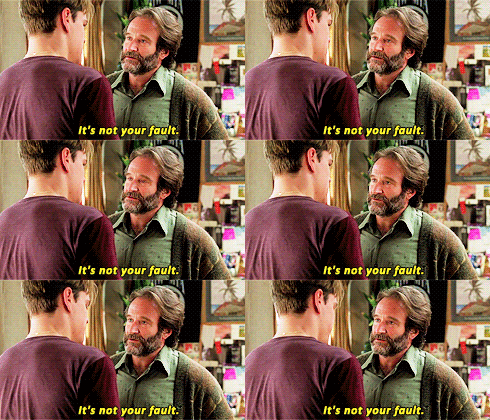
Well, as Robin Williams said to Matt Damon in Good Will Hunting, "It's not your fault, son." Sitting down at the poker table, you only brought a limited amount of willpower to start the session-- and then you ran out. There was a definitive time to quit, but you didn't, so what came afterward was almost preordained.

The good news is that the same Science that shows we have a finite amount of willpower also has proven that our willpower can be improved and increased. In fact, your willpower reserve is a lot like a muscle-- you can exercise it and improve it and bulk it up. It takes time to do so, but it can actually be done. You simply push your boundaries each day a little bit. You resist that Twinkie in the 'frig for fifteen extra minutes before succumbing. Then the next night, you push that delay to 30 minutes. And so on. Pretty soon you're not eating Twinkies in the evening.

You can also learn to quit or avoid bad situations altogether, so that they don't tax your willpower reserves in the first place. This is tougher to do at the poker tables, as the very nature of sitting down at the felt to play is one of agreeing to test our wills against others. He who makes the least mistakes, wins, right? But you can learn to recognize when your psyche is starting to scrape the bottom of the endurance well-- and you have to have enough willpower remaining in that well to stand up and walk away. Sounds easy, right? Sure, it's just a matter of will.

Seriously, try to remember that it's not your fault, son. When you've run out of emotional reserves, you've run out. Period. The secret is a) bulking up those reserves; and, b) minimize how much we tap into those reserves in the first place.

Happy good willpower hunting.

All-in for now...
-Bug


Saturday, May 17, 2014

A Little Stress is a Good Thing

“Emotion is not the problem. It’s the key to mastering your game.”
– Jared Tendler, Poker Psychologist

Unless you’re brain dead or some kind of alien robot, playing poker for money will bring out emotions in you, both good and bad. Playing competitive poker causes stress.

And guess what? Neither of these things is necessarily bad for you or your play. In fact, a little stress and emotional arousal can be beneficial to your game and can give you a competitive edge… but only up to a point. Then things start to go south again. Let me explain.

Many uninformed poker pundits, arm-chair coaches, and so-called experts frequently say that you have to be emotionally dead at the tables. They write things like: “to win at poker you have learn to totally let go of caring,” and “don’t think about the money or how you’re doing—you have to learn to not give a crap.”

I used to buy into this notion, as do many amateur players and otherwise smart people that should know better. For instance, I was reading a well-regarded poker strategy book the other day and saw a quote by Katy Lederer, sister of the infamous poker scoundrels Howard Lederer and Annie Duke. In this otherwise solid book, Katy was quoted as saying:

“The cardinal sin in poker, worse than playing bad cards, worse even than figuring your odds incorrectly, is becoming emotionally involved.”

Sounds reasonable, right?

Bzzzzzzzzzt, wrong!

What Katy espouses is a common misunderstanding of the game by beginners. We (correctly) take the level-1 advice of learning to not focus on the results of a specific poker hand, and we expand it (incorrectly) to mean we should learn to completely divest ourselves emotionally during play. These two things are not the same. The former is good advice, the latter quite bad.

The simple truth is you need to care emotionally. You need to be a little stressed. You need to be aroused and focused and peaked. Or else you’re not playing optimally.

Sports psychologists have known about the relationship between stress and performance for years—over a century in fact. Way back in 1908, the researchers Robert Yerkes and John Dodson performed a series of experiments that resulted in something called, not surprisingly, the Yerkes-Dodson (YD) law.

The YD Law states that performance at a task increases with physiological and/or mental arousal. But depending upon the difficulty of the task, this performance increases only up to a point. When levels of arousal become too high, performance decreases. The process is often illustrated graphically as an inverted U- or bell-shaped curve which increases and then decreases with higher levels of emotional arousal. Here's a cartoon version of the YD Law to illustrate the relationship between arousal and performance:


Continued research in this field has found that different types of tasks require different levels of arousal for optimal performance. For example, simple tasks require a relatively large amount of arousal to achieve optimal performance, while more difficult or intellectually demanding tasks require a lower—but still finite—level of arousal (to facilitate concentration).

Playing competitive poker for money clearly falls into the latter category. Poker is complex and intellectually demanding. This means you need to be emotionally aroused when you play, you need to feel the stress of the game—but only up to a point. Too much stress or arousal can cause sensory overload, fatigue, fear, poor decisions, and so on. In other words: tilt.


Tendler really nails it when he writes that emotions aren’t our enemy at the felt—quite the opposite, in fact. 
Understanding--and using to our advantage--our emotions at the poker table are a fundamental key to mastering the game. And embracing the stress part of poker is part of this over-arching emotional puzzle that is poker.


A little stress does in fact go a long way.

All-in for now...
-Bug

Tuesday, April 29, 2014

Miscellaneous Ramblings


Bankroll Builder. As part of the online education of e-pal (who resides Down Under, btw), I asked him to create his own pregame checklist of things to focus-on/remember during an upcoming session of poker. Number one on his list was:

"Gap Concept - If there is any doubt: FOLD!"

To which I immediately nodded my head and thought:

"Wow. My work here is nearly done."
----

Tilt Hills. Am still fine-tuning my tilt hill and, specifically, the eight major categories of tilt. For instance, this morning I renamed the "anguish" tilt category to a more general category of "frustration." The mildest form of this would be mild irritation or annoyance. The most severe would be what Mike Caro once labeled "Despondent Tilt," or "The Point of No Return."  It's been a long, long time since I felt that one, but I remember it as if it were yesterday. I don't care anymore, just take my money....

---

Side Glances. The title in today's post comes from one of my favorite columnists of all time: the incomparable Peter Egan of Road and Track fame. For years and years I subscribed to R&T, even through the dark days, primarily for Egan's monthly column. Hell, I even subscribed to Cycle World for a while because he penned an awesome monthly there, too. If you're into the internal combustion engine at all, this is a writer to search out.

---

Work. I currently hate my job. I've been assigned what is effectively a second full-time undertaking, which is essentially me being asked to step in and "fix" a dysfunctional, out-of-control group of engineers and scientists. I know very little about the subject matter of the group (high-level science related), the personalities are either very strong minded with their own agendas, or weak/timid folk, and most of the work has already left the station (on uncertain paths). Oh, and I get to double my travel away from home. Joy.

---

Big Bad Government. Still haven't received my Full Tilt remission. I must be on some sort of blacklist. Grrr.


---

All-in for now...
-Bug

Thursday, April 24, 2014

The Eight (Less than Great) Ways to Fall Off the Tilt Hill

Lots of poker authors and experts have attempted to categorize specific types of tilt.  Jared Tendler, for instance, has opined that are seven basic types of generic tilt players experience. Other writers have written that all types of tilt are nothing more than shades of anger (e.g., anger at others, at your own play, and the poker gods, at your luck, etc..). Still others talk about ill-defined things like "winners tilt" and "giving up mentally."

If we use Tommy Angelo's definition of tilt, we should also add in all the non-anger deviations from good play (e.g., boredom, distraction, playing scared above our bankroll, not concentrating, letting ego get in the way of good decisions, gambling vs. maximizing expected value, etc.). In other words, there are lots and lots and lots of types of tilt.

So... I started making a list of all these. And then I made more lists and sub-lists. And then I read more and made more lists. And then I combined and conflated and divided and re-sorted and made even more lists. And slowly things began to jell. In the end, I kept coming back to eight basic categories of tilt; everything else just seemed to be a permutation or subcategory of one of these big eight. My eight categories are:
  1. Anger. This is actually a pretty wide category, including anger at yourself, the other players, your luck, etc.. but it boils down to shades of classic "steaming" tilt at the tables.
  2. Desperation. This is a category that covers behaviors and emotions like trying to get unstuck by gambling it up, chasing hopeless draws, playing above your bankroll, trying to force the action, trying to get bad players to fold, hoping your hand is good instead of folding, etc.
  3. Arrogance. This is nothing more than a person's Ego at play. Winners tilt, pride, arrogance, a sense of entitlement, feeling like you deserve to win because the other players aren't as good as you...
  4. Distraction. Whenever you surf the web when playing online, or check your text messages or the football scores when playing live, you're distracted, and therefore not playing your A-game. Angelo says you're on Tilt. I agree.
  5. Fear. Playing scared or weak-tight are the classic manifestations of this type of tilt. As tournament pros like to say, you have to be willing to die in the game. You need heart to win at poker.
  6. Complacency. Call it laziness and an unwillingness to do things like put other players on hands, or put in that last bet on the river because "the pot is big enough."
  7. Self-Doubt. Self esteem and trusting one's abilities and instincts are paramount to playing well. Can you pull the trigger when the time comes? Do you believe in your read on the villain, or don't you? And if not, why not?
  8. Anguish. This one also covers a wide spectrum, including disgust at one's past mistakes on previous hands, frustration at your luck, grief over a big pot lost... these are all types of anguish tilt.
I will write a lot more about these eight primary tilts in a series of future posts, but first I want to discuss how these are related to each other. Enter our old friend Plutchik and his Wheel of Emotions (first mentioned here).

As I wrote previously, Plutchik charted on a color wheel what he considered to be the eight primary human emotional states:
Note that these states are arranged in so-called "bi-polar" pairs. For example, on the left side of the chart (in red) is the primary emotion of Anger. Opposite of this on the right side (in dark green) is Fear. [Even to laymen like me, it's obvious this particular pairing represents the classic primal choice between fight or flight when facing a threat.] Other primary pairings include Joy vs. Sadness, Disgust vs. Trust, and Anticipation vs. Surprise.

There are also a lot of varying "shades" of each emotion on Plutchik's wheel (e.g., Anger ranges from simple Annoyance to outright Rage). And there are also blendings between primary emotions, such as Anger + Disgust = Contempt. And so on.

Now, I'm not fully convinced that Plutchik captured all significant human emotions on his wheel (at least in terms of poker emotions). Nor do I think he got the ones he did capture necessarily located in the correct area of the wheel (e.g., "boredom" does not feel to me like a shade of disgust-- but then, my degree is in engineering, not psychology, so I could be all wet.) 

Okay, that said, I do believe laying out emotions like Plutchik did on a color wheel, arranged in bi-polar pairs, is genius. So, being a big believer in R-and-D (Rip-off and Duplicate!), I stole liberally from his approach, essentially superimposing my eight categories of tilt on a color wheel of emotions like Plutchik's wheel. Here's my resulting Tilt-a-Wheel of Emotions:


Note the eight primary tilt categories are arranged in bi-polar pairs. Anger vs. Fear, Anguish vs. Distraction, and so on. Are my pairings perfect? No. Are they aligned fully with Plutchik's emotions. Not quite, but overall this layout does seem to fit pretty well with his model. More importantly, mapping tilts like this gives us a fairly reasonable framework that we can use to cognitively work on to improve our resistance to tilt.

For example, if you can recognize that your primary emotional nemesis is one of getting angry at bad beats, then there are all manner of techniques and tactics to a) recognize the trigger stimuli; and b) combat those feeling and put them back into check. The same goes for the other seven tilt emotions; psychologists and psychiatrists have lots of tools in their kits for dealing with these all of these types of things. The trick is first identifying the problem, which I think a spoked color wheel approach lends itself to.

I'm out of time right now, but in future installments on this subject, I want to delve a little more deeply into each of the eight tilt categories, focusing on what stimuli pushes us in that particular emotional cliff direction, and what kinds of tilt resistance is available to combat those slides off the tilt hill. More to come...

 All-in for now...
-Bug

Sunday, April 20, 2014

Bug Gutts and Tilt Hills

In my last post (here), I said I was going to retool my overall thinking on the subject of Tilt. The plan is to combine and refine the collective wisdom of experts like Tommy Angelo, Jared Tendler, Robert Plutchik, Alan Schoonmaker, Lou Krieger, et al into one big simple, cohesive, digestible lump; i.e., a unified way of describing, recognizing, and controlling tilt. Call it Bug's Grand Unified Theory of Tilt, or GUTT.*

To begin this process, let's start with Angelo's definition of Tilt, which states that any time you deviate from playing your best possible "A-Game," or let your thinking deviate from it's ideal "A-Mindset,"  you're Tilting.

Let's also bring in Tendler's main topic of his second book and combine it with Angelo's definition. In the second volume of Mental Game of Poker, Tendler focuses on getting into--and staying in--a so-called "Zone" of ideal play. In other words, I propose conflating Tendler's "Zone" with Angelo's "A-Game" and "A-Mindset." Let's call the result the A-Zone.

For illustration purposes, let's visualize a player's mental state as a location of a ball on a performance hill or cone. When you're playing poorly, you're off the hill, floundering around at the base, frustrated and losing money. As you get your act together and start playing better, the higher up the flanks of the hill you move. At the very top of the hill is a flattened summit called, surprise surprise, the A-Zone. When you're playing perfect poker you're crushing the game up here on top.

Ah, but then you get distracted and begin to slip away from your A-game-- and you roll toward the edge and fall off the A-Zone summit and begin sliding down the flanks of the hill into the abyss called Tilt, where you're back to losing your money. Lots of internal and external stimuli can push you toward and off the A-Zone edge and down into this abyss. Bad beats, coolers, mistakes you can't shake, trying to get unstuck by gambling, losing your patience, letting your ego dictate your play, etc, etc, etc... all manner of negative things can shove you toward the edge:


Back in the day, my old poker coach, the Guru, used to say Tilt was nothing more than 1+1+1. A bad beat pushes you toward tilt. You know you played the hand perfectly, but losing that big pot still stings. Then a few hands later you fold what would have been a winner to a big stupid bluff that a villain shows and gloats about. Then on the very next play your Aces get cracked by Kings... one plus one plus one equals tilt... and suddenly you're rolling down the tilt hill like a snowball gathering momentum on its way to hell.

Everyone's tilt hill is different. Some have wide A-zone summits, others are narrower. Some are dished at top, while others are crowned. Some have the equivalent of guard rails around the top, while others have crumbly edges ready to collapse at a moments notice. Some players only need "1" to get pushed over their edge, while others need 1+1+1+1+1... well, you get the idea.

In the next installment on this topic, I want to discuss a bit more about the different directions you can be shoved off the hill. And to help visualize that, we'll return to our old friend Robert Plutchik and his Wheel of Emotions.

All-in for now...
-Bug
*The real Grand Unified Theory (GUT) is in fact one of the holy grails of modern physics, and often seen as the necessary stepping stone between our current understandings of physics (i.e., general relativity, quantum physics, and good old Newtonian physics), and the quest for a Theory of Everything (TOE). Seriously. Look it up.


Sunday, March 30, 2014

Bug's Poker Tip #39

Poker Scores Ain't Like Football Scores

I got this one from a really old David Sklansky training video. It's kind of obvious, but important nonetheless. Here's the idea: In football, it doesn't matter if you lose 30-28 or 30-0, you still lose the game, period. The actual score doesn't matter the next day or the next week. In poker, the score at the end of a session does matter. This is because in poker the "score" is cumulative to your bankroll. Poker is best thought of as one long session that continues for years. If you go on tilt in even one session and dump off a lot of money, you will hurt your overall bottom line for the year. It's like starting the next session in the hole. You don't want to spot the other side a handful of touchdowns before the kick-off, right? You need the discipline to a) recognize tilt as it's coming on; and b) leave the table before the other side runs the score up on you. Just punt and go for a walk. Your bankroll at the end of the year will thank you.

All-in for now...
-Bug

Monday, October 14, 2013

On Human (Tilt) Bondage: Emotional Control at the Poker Table


The importance of the mental and emotional control aspects of a game like poker cannot be overstated. Every single poker player—from rank beginners to the most experienced professionals—lose money that they should never have to part with. Yes, this means you! And this means me, too.

We all do this because we’re humans, and humans experience emotional mood swings that leads them, er, us, to poor play. Said simply, humans “tilt.”

That’s the bad news; we’re all human. We have emotions and feelings constantly burbling and swirling within us... and this is all going on whilst we’re simultaneously trying to master a game that essentially requires us to be devoid of emotion. We need the ability to suffer bad beats with nary a blip on our emotional register. We have to shrug off coolers like they were nothing more than a harmless gnat buzzing about our head. We have accept losing coin flip after coin flip with carefree indifference. And through all of this, we have to stay on our A-game, playing perfect, disciplined poker...

And I probably don't have to tell you this, but playing like an emotionless android while watching your Aces get cracked yet again by the likes of 7-2o by the worst player at the table is really, really, REALLY hard to do. Why? Because we’re humans, dammit!

Ah, but there’s a glimmer of good news on the horizon on this emotionally troubled sea. As part of putting together the outline of the "Emotional Control" section of my Poker Pyramid of Skills, I've been reading a handful of poker “psychology” books, trying to piece together the collective experts' thoughts on common tilt and psychology issues, along with strategies for recognizing and minimizing their effects on our play. The books I'm reading are: Jared Tendler’s truly excellent The Mental Game of Poker, Ian Taylor/Mathew Hilger's very good The Poker Mindset, Tommy Angelo's classic The Element's of Poker, and Alan Schoonmaker's somewhat disappointing Your Worst Poker Enemy. I've also got Tendler's sequel to Mental on my Amazon to-buy list, as I've heard it's a very good follow-on treatment.

Anyway, as I said, there is some good news on the poker emotion front. In the course of putting together notes and reading all these books, it now appears to me that our human poker frailties fall into just a few common, recurring categories, or themes if you will.  Better still, there seem to be definitive tips, techniques, and strategies for dealing with each of these common issues. Here are the broad Emotional Control categories as I currently see them:
  1. Plane Jane Tilt. Tilt is basically nothing more than Anger, writ poker style. Tilt can be due to running bad, feelings of injustice, feelings of entitlement, revenge, desperation, superstition, and so on, but they're all nothing more than fifty shades of anger.
  2. Lack of Patience and/or Discipline. We want to play poker, dammit. We didn't come here to fold, even though we know we should...
  3. Lack of Focus. We humans are lazy creatures. We're not easily motivated. We're not good at situational awareness. We suck at paying attention. We've mucked, and we'd rather be reading a novel on our iPad or watching the football game on the TV instead of putting the other active players on hand ranges.
  4. Confidence Issues. We've been losing hand after hand, session after session, and we begin to wonder if we're actually capable of ever beating this damn, stupid, f*cking game... 
  5. Ego Issues. This is the flip side of Confidence issues. We're better than these idiots at the table. We feel entitled to win.... i.e., we think we're better than we actually are.
  6. Heart. We play scared, without heart. We're not trusting our reads, and we're certainly not acting on them. We're so afraid of "dying" that we'll never actually live and thrive at the tables.
All poker players lose money at the tables, and they do so because they've succumbed to one or more of these six basic psychological pitfalls. Mastering control of your emotions at the poker table is paramount to mastering the game. Tilt control, discipline, focus, confidence, ego control, and heart—these are the keys to mastering the emotional side of the game.

Well, at least as I see it. I could be wrong. I'm only human, after all....

All-in for now....
-Bug

Friday, March 15, 2013

Categorizing the Mental Game

Read an interesting article the other day by Jared Tendler, who is a relatively well-known "mental game" poker coach, specializing in emotional problems and control. In this article, Tendler breaks down the mental/emotional issues that affect the majority of players into four basic categories:
  1. Tilt. Unlike Tommy Angelo and others who call "tilt" any play that is less than your A-game, Tendler believes that most tilt is in fact a form of anger. The cause of that anger can be many things, such as running bad, revenge, bad beats, hating to lose, making mistakes, feeling cursed, etc., but the bottom line is that tilt = anger. Anger management is therefore key to controlling this emotional leak in your game.
  2. Fear. This is another big area of mental anguish that affects players. Fear can manifest itself by such things as over-thinking decisions, mind going blank in big pots (deer in headlights), feeling rushed, avoiding higher variance plays that you know are right, and just feeling overwhelmed or out-matched by better players than you.
  3. Motivation. Tendler says that you can be over- or under-motivated at the tables, and this can affect your play.
  4. Confidence. Finally, Tendler says that you have to have confidence to play poker well, but too much is just as bad as too little. Being overconfident can lead you to play too aggressively, play at limits too high for your abilities, and ignore advice or lessons at the table. Similarly, being under-confident means you trust your gut too little, can't pull the trigger, and so on.
FWIW, and while I am certainly not the expert Tendler is, I'm not sure I fully agree with these categories. In fact, the more I think about it, the more I still like my own three major categories of Emotional Edges:
  1. Tilt. I think Tendler has this one mostly right when he talks about anger being the chief component of tilt, but I think there can also be a "I just don't care anymore" flavor of tilt that is just as dangerous to your bankroll. I personally know one player that I've seen do this multiple times in the past; he takes a beat or two, and instead of getting "angry" and tilting off his money, he just starts playing stupidly and saying things like, "it doesn't matter" and "I suck anyway" as he tilts away his bankroll.
  2. Discipline. A huge emotional issue that can mean the difference between winning and losing is simply being able to play an emotionally controlled, patient, RDM, disciplined game. Diligently paying attention, folding when you're beat, betting when your supposed to, implementing REDi, etc. all takes mental "toughness" or discipline.
  3. Heart. I think Tendler's categories of Fear and Confidence both are part of this emotional component. But there's more, too. I wrote a blog post on the subject a few months ago (see here) that covers it in more detail.
The one thing on Tendler's list that isn't on mine is the Motivation thing. While I agree this can be an issue, I don't really see it manifesting itself purely as an emotional mental game thing, as much as I do as a bankroll management concern.

All-in for now...
-Bug


Thursday, March 14, 2013

Tilt Mantras

Read an interesting article by Jon Vorhous the other day on the subject of Tilt. In it, he writes about some of the things he tries to tell himself when getting tilty at the tables. While I'm not sure how useful these really are, I did find them entertaining, if not a little thought-provoking:
  • We're born broke; we die broke; everything else is just variance.
  • If it won't matter in 20 years, it doesn't matter now.
  • A bad beat is just a temporary setback; [it will correct itself].
  • [Shit] happens.
He also embraces the concept of a stop loss; i.e., walking away when "you've lost more than you can reasonably expect to win in the next session."

And finally, when you need something to break the mental logjam/anger/tilt of a bad beat or session, Vorhous recommends forcing yourself to think about something else in your life that gives you a feeling of success and/or pleasure. He gave the example of once tilting on a golf course. After a bad shot, his playing partner asked him, "So, how's that screenplay gig coming along." This took Vorhous' mind away from the game, and supplanted something positive in its place. His game immediately improved.

The mind truely is a bizarre and fascinating place.

All-in for now...
-Bug